


Top 10 AI UI UX design and development agencies in 2026 | Expert guide


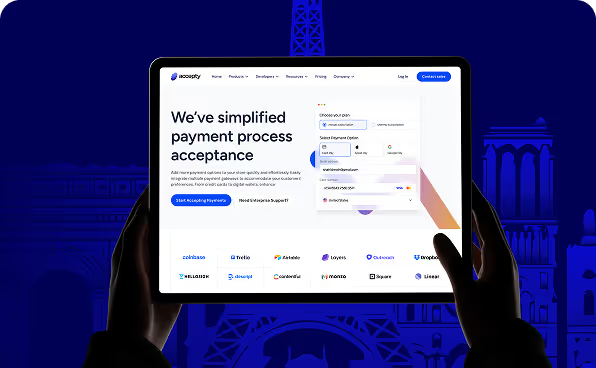


Looking for the best AI UI UX design agencies? You're in the right place.
AI is transforming the design of digital products. Firms are currently developing smarter applications and websites using AI. These applications are self-taught and adaptive.
This list will reveal the most popular 10 AI design agencies in 2026. You will know what they do, who they deal with, and how to choose the right one.
“The AI design market grew 45% in 2025. Businesses using AI design see 3x more user engagement. They also launch products 40% faster.”
Let's find the perfect agency for your project.
Target audience: Who this blog is for
This guide helps:
- Startup founders building AI-powered products
- Product managers improving user experience with AI
- Marketing leaders want personalized customer journeys
- Business owners competing with AI-driven companies
- CTOs and tech teams searching for AI design partners
You don't need to be a tech expert. This guide uses simple language. Anyone can understand it.

What is AI UI/UX design and development?
What is AI design?
AI design uses artificial intelligence in the design process. It helps create smarter interfaces.
Here's what AI design includes:
- Tools that generate multiple design options automatically
- Systems that predict what users will do next
- Software that tests designs without human help
- Interfaces that change based on user behavior
Think of Netflix. It shows different content to different people. That's AI design in action.
What is AI UX design?
AI UX design creates experiences that learn from users. Unlike regular design, it adapts over time.
Examples include:
- Shopping sites that recommend products you'll like
- Apps that predict your next action
- Search bars that understand what you mean, not just what you type
- Chatbots that give helpful answers
Regular UX design is the same for everyone. AI UX design is unique for each person.
What is AI development?
AI development builds the tech behind smart experiences. Design agencies do this work.
They create:
- Chatbots that talk like humans
- Recommendation systems for products or content
- Image recognition tools
- Predictive analytics dashboards
- Custom AI models for specific needs
Good agencies combine design skills with AI technical skills.

AI-powered design & development vs traditional approach
We are evolving rapidly in how we make digital products. Conventional practices are based on handwork and fixed procedures. Machine learning is applied in AI-based solutions to automate tasks, make predictions, and personalize experiences.
This is the main difference: Traditional design and development are pattern-oriented. Through real user data, AI-powered methods will evolve and become better. This makes products smarter, quicker to construct, and easier to utilize.
We will compare the two methods with each other:
AI-Powered Development vs Traditional Development
Modern AI development differs from traditional coding in key ways:
Traditional development is based on human expertise only. AI development refers to using machine learning to accelerate work and identify issues at an early stage.
This does not substitute for developers. It increases their productivity. Products are shipped 30-50% faster in teams that employ AI development tools.
AI-powered UX vs traditional UX
The main difference? Conventional UX is a response to the familiar. AI UX predicts the user requirements.
Why your business needs an AI design agency
Introducing AI into user experience is not a choice anymore but a competitive requirement. This is why collaborating with AI UX design agencies is the key to changing your business:
1. Faster Time-to-Market
Design workflows and AI design tools help to cut design cycles by 40-60%. Automated design generation, instant prototyping, and AI-powered testing allow agencies to deliver production-ready products in weeks instead of months.
2. Hyper-Personalized User Experiences
Users are now demanding Netflix-level customization of all digital products. The AI agencies will be able to use recommendation engines, adaptive interfaces, and personalized content strategies, which will engage 3-5x more than the traditional design.
3. Data-Driven Design Decisions
Rather than just using the designer's intuition, AI agencies apply predictive analytics and user behavior modeling to make evidence-based design decisions. This saves the cost of costly redesigns and boosts the conversion rates by 25-40%.
4. Scalable User Research
Traditional user research techniques are not scalable. With AI-powered agencies, it is possible to examine millions of user interactions, identify patterns of behavior, and produce actionable insights at any moment in time, which is not possible when using manual techniques.
5. Competitive Advantage
According to Forrester research, the companies that have an AI-powered customer experience increase revenue 1.5 times faster than others. Your industry may have early adopters who have already been taking advantage of such capabilities.
6. Cost Efficiency Over Time
Although it might be more expensive at first, AI systems can save more on long-term operation expenses due to automation, lower customer support requirements (through smart chatbots), and lower churn rates (through personalization).
7. Future-Proof Technology Stack
The AI design agencies are working with new technologies, large language models, computer vision, and edge AI so that your product stays up-to-date as user expectations change.Forrester Research found that AI-powered personalization can increase conversion rates by 10-30% and customer engagement by 20-40%.
How to choose the right AI design agency (5 Key Factors)

When choosing the appropriate AI UI UX design agency, it is necessary to consider factors other than traditional design portfolios. Here's a comprehensive framework:
1. Portfolio & AI project experience
What to look for:
- Examples of real-life applications of AI (not necessarily AI-based design).
- Projects showing measurable results: engagement lift, conversion improvements, reduced support tickets
- Variety of AI applications: recommendation systems, chatbots, predictive interfaces, generative tools
- Your industry (fintech AI is not healthcare AI) experience.
Red flags:
- No AI-specific projects in the generic portfolio.
- No productions, just conceptual work.
- No measurable outcomes and measurements.

2. Technical expertise (ML, GEN AI, Data Science integration)
Questions to ask:
- Do they have in-house data scientists and ML engineers?
- What are the AI frameworks that they operate with? (TensorFlow, PyTorch, OpenAI API, Anthropic Claude, etc.)
- Can they build custom ML models or only integrate third-party APIs?
- What do they do with the privacy of data and training models?
- What's their experience with generative AI (GPT-4, DALL-E, Midjourney integration)?
Technical capabilities checklist:
- Chatbots and semantic search via Natural Language Processing (NLP).
- Image recognition and visual search in computers.
- Algorithms of recommendation (collaborative filtering, content-based)
- Big data and user behavior modeling.
- Automation and optimization of A/B testing.
3. Design thinking approach
AI is not supposed to design, but be used to complement the human-oriented design. The most successful agencies are those that are both technical and user-friendly.
Evaluate their process:
- Do they start with user research or jump straight to AI solutions?
- What do they do to make AI recommendations user-focused?
- What's their approach to explaining AI decisions to users (transparency)?
- How do they handle AI limitations and edge cases?
- Do they design ethical AI experiences (bias mitigation, consent, control)?
4. Client testimonials & case studies
Look for specifics:
- "Raise personalization by using AI and convert it by 35%" (quantifiable).
- "Reduced customer support tickets by 50% with intelligent chatbot" (measurable impact)
- "Predictive content delivery increased the user retention by 28%" (business outcome)
Warning signs:
- Vogue testimonials: "Good to collaborate with, highly recommended.
- No case studies with metrics
- Not willing to introduce you to former clients.
5. Post-launch support & scalability
Artificial intelligence needs continuous training, control, and streamlining. Ensure the agency offers:
- Model monitoring: Performance tracking and drift detection
- Continuous improvement: Regular model retraining with new data
- Technical support: Bug fixes, updates, API changes
- Scalability planning: Infrastructure that grows with your user base
- Knowledge transfer: Documentation and training for your internal team
Pricing models to consider:
- Fixed project cost + ongoing maintenance retainer
- Performance-based pricing (pay based on results)
- Build-operate-transfer (agency manages initially, then hands off)
Top 10 AI UI UX Design Agencies in 2026
Following a review of more than 50 agencies on AI skills, customer base, technical skills, and reputation, the following are the top AI design and development agencies that will determine digital experiences in 2026.
Shortly, I’m giving you the top AI design and development agencies' names:
1. Wavespace

Wavespace is an international UI/UX design and digital product agency to enable startups, SaaS businesses, and tech brands to create compelling user-oriented digital products, whether it be web and mobile applications or complex SaaS platforms.
What They Do Best:
- Web, mobile, and SaaS products design.
- AI Product design and digital strategy.
- Webflow design and development.
- UX research, design systems, and UX consultancy.
- Branding and MVP development for AI SaaS
Real Projects:
Call AI, Brainwind AI, Rooda, Sendwave, Kodezi, Mediqo, Delve, HeyGen
Best For:
Startups, SaaS, digital platforms, and businesses requiring the services of holistic design of the UI/UX work, from idea to implementation.
Location:

2. Cieden

Cieden is a product design and UX/UI agency that is specialized at designing complex enterprise and B2B SaaS platforms into a simple and easy-to-use experience. They assist teams in simplifying and making complex systems more efficient by designing and researching.
What They Do Best:
- Complex workflow and enterprise UX/UI design.
- Design of data visualisation and data dashboards.
- Design systems and scalable UI components
- AI-informed UX and feature integration to enhance user experiences without overcomplication
Best For:
B2B SaaS, enterprise analytics platforms, workflow-heavy systems, and products where clarity and usability drive adoption.
Location:
Remote-first and teams in the US, Europe, and Canada.
3. Punchcut

Punchcut is a design and innovation consultancy that designs human experiences of digital products across related and emerging technologies, including mobile and web interfaces and intelligent and multimodal interactions.
What They Do Best:
- User experience approach and design.
- Smart product interface design.
- Voice, autonomous, and immersive innovation.
- Future-prototyping and design research.
Real Projects:
Google, Amazon, Samsung, LG, Ford, Fitbit, Visa, Toyota
Best For:
IoT and connected device experiences, voice and conversational interfaces, smart products, and forward-looking platforms that need design leadership at the intersection of software and hardware.
Location: San Francisco, California, USA.
4. Fantasy

What They Do:
Fantasy is a worldwide, prize-winning digital product and design firm that collaborates with leading brands to develop next-generation smart experiences, integrating human-focused design, product creation, and an AI approach to roll out advanced digital experiences.
What They Do Best:
- User-focused digital product design and UX/UI.
- AI strategy & execution
- AI-driven product innovation.
- Brand and identity systems
- Brainstorming and testing of intelligent experiences.
Real Projects:
Salesforce, Nike, Meta, Google, Microsoft, Amazon,
Best For:
Facing consumers, enterprise digital platforms, and brands that seek beautiful and smart UX and consider AI with care.
Location: San Francisco & New York (remote-friendly).
5. Lazarev

Lazarev is an AI-driven digital product design agency that focuses on UI/UX design, AI experience design, product strategy, and digital transformation of startups and growing tech products. They help teams to create intuitive and human-focused online experiences, particularly regarding products that are driven by complex technologies such as AI and data.
What They Do Best:
- AI and data-driven product UX/UI design.
- End-to-end web and app design with AI-driven insights.
- Artificial intelligence research and design.
- Growth optimization and conversion-based design.
Best For:
AI, SaaS, FinTech, Web3, healthcare, and data platform startups and tech teams that require product and UX design that scales with advanced technology.
Location: San Francisco, California, USA, with a globally remote-friendly workforce.
6. Superside

Superside is a creative-as-a-service platform that provides design and creative production on a subscription basis to growth teams and companies. They use the best creative minds and AI-enhanced processes to generate high-quality design outputs in a short amount of time.
What They Do Best:
- AI creative design and implementation.
- Subscriptions to sustainable, continuous creative assistance.
- Scalable brand and scaled visual and UI/UX.
- Ad creatives, web and digital design, motion graphics.
Real Projects:
Microsoft, Reddit, Amazon pharmacy
Best For:
Digitally progressive companies, those that require continuous design at scale, and growth and marketing teams.
Location: Remote-first (global, with clients worldwide).
7. Noomo Agency

Noomo is a digital design agency, award-winning, and a boutique that creates interactive digital experiences, immersive 3D websites, and interfaces that tell stories. Their output is a combination of UI/UX design, motion, and 3D interaction, advanced web experiences that make digital platforms very engaging.
AI & Immersive Experience Capabilities:
Their work shows that AI can be incorporated into creative digital experiences, which change their behavior, preferences, and interaction.
Core Services:
- Immersive digital product design and storytelling
- Interactive website and WebGL/3D experience design
- UX/UI design with motion & engagement focus
- Online strategy and brand activation experiences.
- Developed custom interactive platforms with conversion and engagement.
Real Projects & Examples:
Noomo Beat, Salesforce Agentforce 360 interactive platform, Intel, AMD, Coinbase.
Best For:
- Brands and products requiring high-impact web experiences.
- Firms that use AI or personalisation in UX.
- Digital activations of marketing and a 3D-based storytelling platform
Location: Remote-based agency headquartered in Los Angeles, California, USA.
8. StanVision
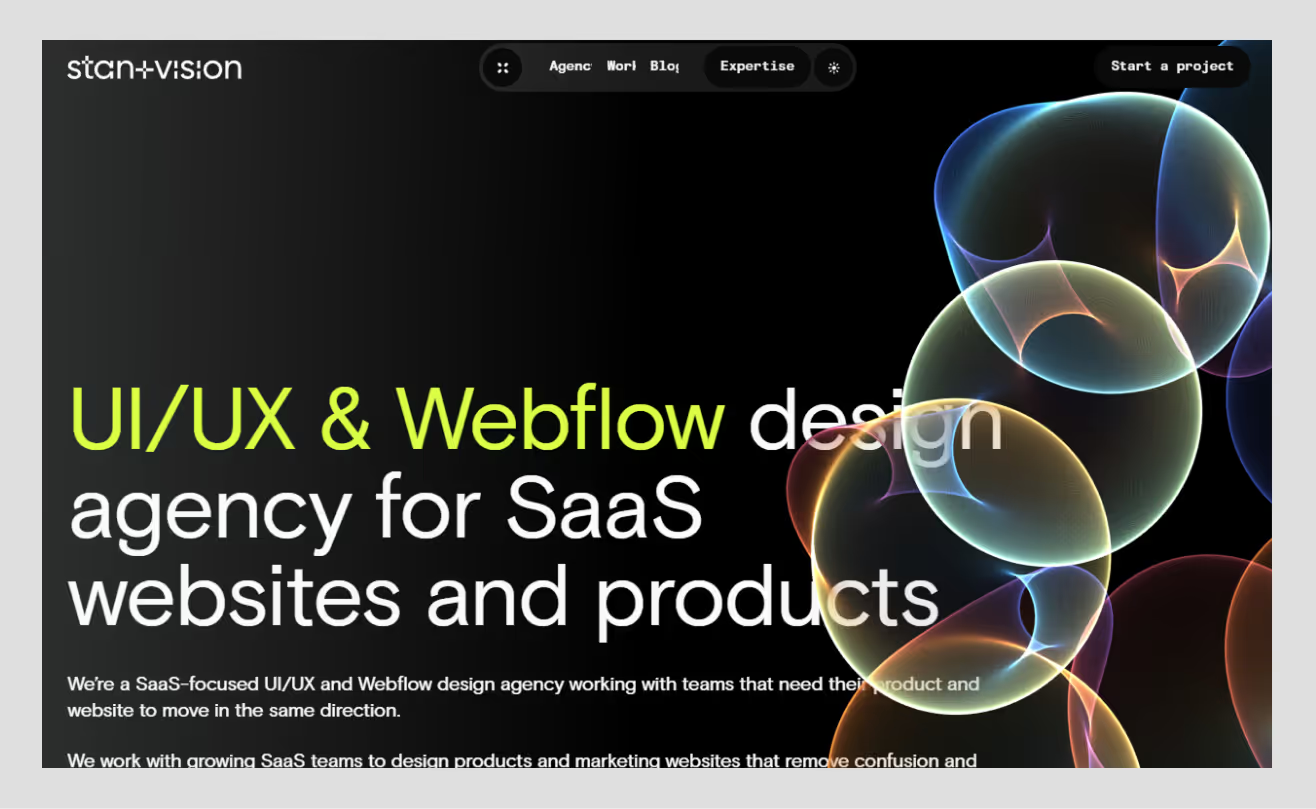
StanVision is an agency specializing in UI/UX and Webflow design, AI-based interface design, and working with teams to create complex AI/ML-based systems into easy-to-use interfaces. They also strive to make complex technologies easy to comprehend and operate.
AI & UX Capabilities:
- AI UI/UX design for intelligent products (e.g., dashboards, predictive interfaces)
- Machine learning products with human-centered design.
- Adaptive and conversational UI of AI interactions.
- Clear, engaging onboarding for AI platforms
- Clear graphics and user-friendly complex technology processes.
Digital Design Core Services:
- SaaS product UI/UX design
- Webflow website design & development
- Product strategy & UX research
- Digital strategy and design systems
Real Projects & Results:
Zipchat AI, Siena, Tolstoy, Contiant, Rillet
Best For:
AI & ML platforms that need UX/UI help turning smart technology into simple, actionable user experiences; SaaS startups looking for product and website clarity.
Location: Remote-friendly, working with global clients.
9. Koncepted

What They Do Best:
Koncepted is a design and creative services agency that focuses on high-velocity UX/UI design, product design, and brand work, which includes strategic AI consulting and production support, which is part of their offering.
AI-Focused Capabilities:
- AI strategy and implementation road maps.
- Workflow design and AI optimization
- Change management and team training.
- AI processes quality and governance.
- Measuring performance and ROI systems.
(These are included in their services under AI Production and Strategic Consulting).
What Else They Do:
Koncepted provides a wide range of creative solutions in product design, User Interface/User Experience, branding, Webflow design, illustration, motion graphics, etc., and works with Web3, gaming, fintech, SaaS, and AI.
Best For:
Mid-size and enterprise brands that require combining the high-impact design with AI transformation support, particularly those that are in Web3, fintech, gaming, and SaaS.
Location: Remote-friendly with offices in San Juan, Puerto Rico (and global team presence).
10. Composite

What They Do Best:
Composite is a digital design and development agency specializing in high-performance UI/UX design, Webflow development, and scalable website builds, with an informed approach to AI UX and agent-aware experiences. They help startups and businesses develop unambiguous and contemporary online platforms that would suit growth and usage.
Core Services:
- Product-oriented design systems and UX.
- Enterprise webflow design and development.
- Branding, motion, and 3D design
- Digital strategy and web performance optimization.
AI-Related Capabilities:
Although Composite does not develop underlying AI models or even bespoke machine learning platforms, they do publish thought leadership on how AI (particularly agentic AI and machine-active interfaces) transforms UX and marketing processes. This makes them a design-oriented collaborator of AI-based digital experiences instead of a tailored AI engineering company.
Real Projects:
Gather AI, GoodWork, Blockaid, AutoTrader, Notable Health, Galehead
Best For:
Technology firms and startups that prioritize performance-based UI/UX, Webflow websites, and product design, particularly those that add AI capabilities to their online experiences (e.g. dashboards, autonomous agent interactions).
Location:
Headquartered in Brooklyn, New York, USA (with remote collaboration options).
Key Takeaways to remember
Here's what you need to remember:
- Design thinking is an interface design technique that integrates machine learning capabilities with design knowledge to develop a responsive, intelligent user experience.
- The most effective agencies strike a balance between the technical and human-centered design. AI should enhance, not replace, user empathy.
- Search agencies that have experience in AI projects and not conceptually, and quantifiable results are important.
- The support after the launch is also very important; AI systems have to be constantly monitored, retrained, and optimized.
- Various agencies are experts in various AI applications, and align their services with your needs (e-commerce vs. healthcare vs. enterprise).
- The AI design market is increasing by 45% each year; early adopters have enormous competitive edges.
- The AI UX that succeeds is invisible; customers get the benefit of being smart without being threatened by technology.
- The great agencies and the good ones differ in ethical AI (transparency, mitigation of bias, control by users).
- AI design ROI is expected to be seen in 3-6 months in terms of engagement, conversion, and lower support costs.
- The future of digital products is adaptive and personalized, and the static experience will not satisfy users anymore.
Conclusion: Pick your AI design partner
Artificially intelligent experiences are no longer optional. Users want to be personalized at all times.
Quick guide to choosing:
- Enterprise companies → Wavespace, Koncepted
- B2B SaaS → Cieden, Noomo Agency
- Consumer apps → Fantasy, Lazarev
- E-commerce → Noomo Agency, Superside
- Custom AI tech → Composite, Lazarev
- IoT devices → Punchcut
- Visual AI → Stan Vision
Identify 2-3 agencies as shortlisted. Review their portfolios. Request proposals. Begin with a small discovery project to test the partnership.
It is not only about adding AI capabilities. It is redefining the user interface with your product. The correct agency will question your ideas and give quantifiable results.

Industry-specific citations
For E-commerce:
Salesforce found that 84% of customers say the experience a company provides is as important as its products, with AI personalization driving 26% higher purchase rates.
For Healthcare:
Accenture predicts that AI applications in healthcare could save the US healthcare economy $150 billion annually by 2026.
For B2B SaaS:
A study by MIT Sloan found that companies using AI for B2B sales see 50% more leads and 60% lower cost per lead.
FAQs About AI UI UX Design Agencies

AI UI UX design agencies develop digital products based on artificial intelligence. They employ designers, data scientists, and AI engineers. These agencies develop recommendation engines, chatbots, personalization, and prediction. They do not design AI products but design with AI.
Small AI features cost $15,000-$50,000. The price of full AI product development is 75,000-250,000. Enterprise AI projects may cost over half a million. The majority of the agencies cost 20-40% higher than the standard design agencies. But you will receive quantifiable benefits in increased sales, enhanced interaction, and reduced support expenses.
Periodic agencies make fixed designs. AI agencies develop learning and adapting systems. Only regular agencies have designers. There are also AI agencies that have data scientists and ML engineers. Periodic designs remain unchanged. The AI designs are user-specific. Periodic agencies are initiated and abandoned. Optimization is offered continuously by AI agencies.
Check five things:
(1) Real AI projects in their portfolio with metrics,
(2) Technical team, including data scientists,
(3) A clear process that starts with user research,
(4) Client reviews with specific results,
(5) Ask for case studies, interview former customers, and begin with a paid discovery stage until full commitment.
Five industries see the biggest impact:
(1) E-commerce - personalized recommendations increase sales 30-60%,
(2) Healthcare - AI assistants improve patient care,
(3) Financial services - fraud detection and robo-advisors,
(4) SaaS platforms - smart dashboards and predictive tools,
(5) Media - content recommendations drive engagement; any business with many users or complex decisions benefits from AI design.

More related blog


Have a Project? Let’s talk!






.png)




















.png)
.png)
.png)
.png)

.png)


